"Bro, just lend me your bank account for a few days. Money will come in, you transfer it out, and you keep ₹5,000." Messages like this are going around college groups, Telegram channels, Instagram and job sites. It sounds like easy money. It is actually one of the fastest ways for an ordinary person to end up with a frozen bank account, a police notice and a criminal case.
As a banker, I see the other side of these offers. In this post I explain in simple words what a mule account is, how banks now use artificial intelligence (AI) to catch them, and why you should never rent, sell or "lend" your account.
What is a mule account?
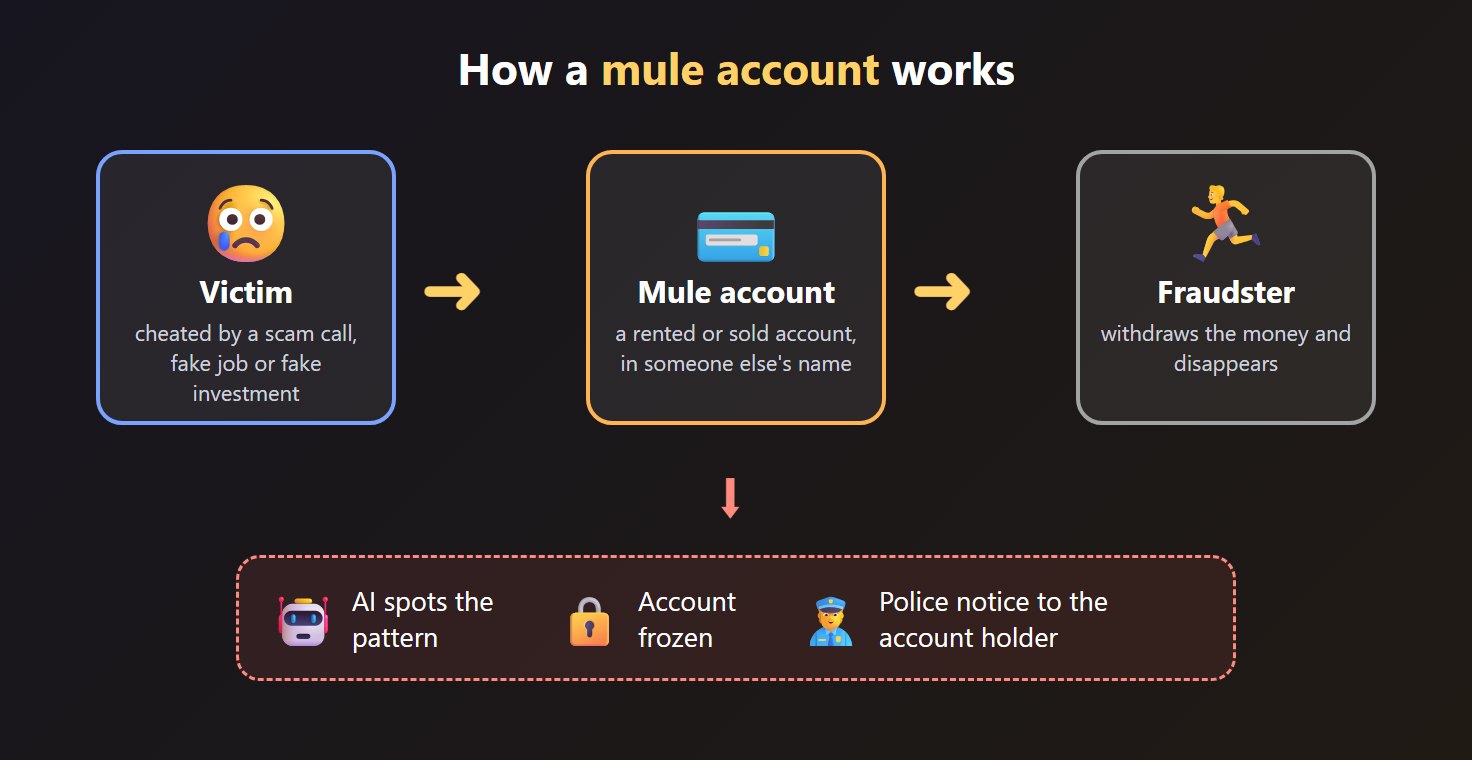
When fraudsters cheat someone through a fake investment, a "digital arrest" call or a fake job, they cannot keep the stolen money in their own accounts; they would be caught at once. So they move it through many other people's accounts to hide the trail. These middle accounts are called mule accounts, and their owners are called money mules.
How people become money mules
- "Account rental" offers: ₹2,000–₹10,000 a month to "use" your account, often aimed at students, daily-wage workers and the unemployed.
- Fake jobs: "Payment processing agent" or "work from home" jobs where your task is to receive money and transfer it onwards.
- Selling a "spare" account: people open a new account, hand over the passbook, cheque book, debit card, SIM and net banking login, and forget about it.
- Gaming and betting groups: "Use your account for deposits, earn commission."
- Without knowing: sometimes fraudsters open accounts using someone's stolen or misused KYC documents. Never give your Aadhaar, PAN or photos to strangers.
How banks catch mule accounts with AI
Earlier, banks used fixed rules, such as "flag the account if more than ₹X comes in within a day". Fraudsters learned these rules and worked around them. Now banks use AI and machine learning, which learns the patterns of mule accounts from thousands of past cases.
The Reserve Bank Innovation Hub (set up by RBI) developed an AI tool called MuleHunter.AI, launched in December 2024 and now used by more than two dozen banks. It looks at how an account behaves, for example:
- An account that was quiet for months suddenly receives many credits from strangers.
- Money comes in and goes out within minutes ("pass-through" behaviour).
- Many small credits from different cities, followed by quick ATM or UPI withdrawals.
- The phone, device or location used for the account does not match the customer's usual pattern.
- The account is linked to other accounts already reported for fraud.
When the AI flags an account, the bank can examine it, restrict transactions and inform the authorities. The government's Indian Cyber Crime Coordination Centre (I4C) also runs a Suspect Registry (since September 2024) with banks, so a mule account found in one place can be flagged across the system. Lakhs of mule accounts have already been frozen.
What happens to a money mule?
- Your account gets frozen, often with your own salary or savings stuck in it.
- Police notices, sometimes from another state where the victim complained.
- A criminal case. Receiving and moving fraud money can be treated as cheating and conspiracy, and can also attract money laundering laws. "I only lent my account" is not a defence.
- Your details may be flagged across banks, making it hard to open accounts or get loans later.
- The fraudster disappears. The account, the transactions and the KYC are in your name, so you face the consequences.
Already given your account to someone? Do this now
- Stop at once. Do not receive or forward any more money.
- Visit your branch and ask to block net banking, UPI and the debit card, and reset passwords. Change the mobile number linked to the account if the SIM is with someone else.
- Tell the bank honestly what happened, and give the details of the person who took the account.
- Report it on cybercrime.gov.in or call 1930, and keep the acknowledgement. Coming forward early shows good faith.
- Get legal help if you receive a notice. Free legal aid is available through your District Legal Services Authority (call 15100).
If your account has been frozen because of a cyber complaint, read my step-by-step guide: Bank account frozen after a cyber complaint.
How to protect yourself and your family
- Never rent, sell or "lend" your bank account, debit card, cheque book, UPI, net banking login or SIM, not even to friends.
- Ignore any job where your work is to "receive and transfer payments".
- Do not share your Aadhaar, PAN or photos for "account opening" with strangers or agents.
- Close accounts you do not use, rather than leaving them idle.
- Talk to young people in your family. Students are the main targets of these offers.
Got a message offering money to "use your account"? Paste it into the free Scam Message Checker.
Frequently asked questions
What is a mule account in simple words?
It is a bank account used by fraudsters to receive stolen money and pass it on, so the money cannot be traced easily. The account usually belongs to someone else who rented or sold it, or whose documents were misused.
Is it illegal to rent my bank account?
Letting others use your account to move money that turns out to be fraud money can make you part of the crime, and you can face a criminal case, a frozen account and police action. Banks also prohibit handing over your account to others.
What is MuleHunter.AI?
It is an artificial intelligence tool developed by the Reserve Bank Innovation Hub (RBIH) to help banks detect mule accounts by studying transaction and account behaviour. It is used by many Indian banks.
My account was frozen as a mule account, but I did nothing wrong. What should I do?
Visit your branch, ask for the details of the hold in writing, and give proof of your genuine transactions. Ask the bank to raise your grievance on the government's cyber crime grievance module. See my guide for frozen accounts.
Sources
- RBI Innovation Hub develops MuleHunter.AI to combat mule account frauds (Business Standard, December 2024)
- Centre freezes 4.5 lakh mule bank accounts used in cyber fraud (Business Standard, November 2024)
- I4C alert on illegal payment gateways using rented and mule accounts (All India Radio News, October 2024)
- Banks using MuleHunter.AI (MediaNama, December 2025)